A public university with eight decades of engineering tradition in Anhui.
Anhui University of Science and Technology (AUST) is a key provincial university jointly built by Anhui Province and the Ministry of Emergency Management, with campuses in Huainan and Hefei and a motto of Unity, Striving, Erudition, Dedication.
Founded 1945
One of China's earliest coal-industry higher education institutions.
Three Campuses
Main, West and North campuses across Huainan and Hefei.
Distinctive Discipline
Engineering-led with science, medicine, management and the arts.
Research Strength
State Key Laboratory of Deep Coal Mining Response and Disaster Prevention.


A campus shaped by mining heritage, opened to the world.
From a single-discipline mining institute to a multi-disciplinary university, AUST brings together more than 4,300 staff and around 31,000 full-time undergraduate students across its Huainan and Hefei campuses.
The university's emblem combines a miner's pick and a key — symbols of heritage, industry and the pursuit of knowledge.
The intersection of art, architecture, and digital technology opens new pathways for rethinking how spaces are conceived, built, and experienced. Rather than treating these disciplines as separate realms, a growing movement seeks to weave them together into a continuous design conversation. This approach allows structures to become more than static containers; they evolve into responsive environments shaped by data, material behavior, and human interaction, reflecting a deeper understanding of the relationship between built form and lived experience.
Parameterized and performative skins represent a shift away from inert building envelopes toward dynamic surfaces that actively mediate between interior and exterior conditions. By encoding environmental data into the geometry of facades, designers can create systems that adapt to light, heat, and airflow in real time. These informed skins draw on computational logic and material intelligence alike, producing architectures that breathe, filter, and respond rather than simply shelter. The result is a more symbiotic relationship between a building and its surrounding ecology.
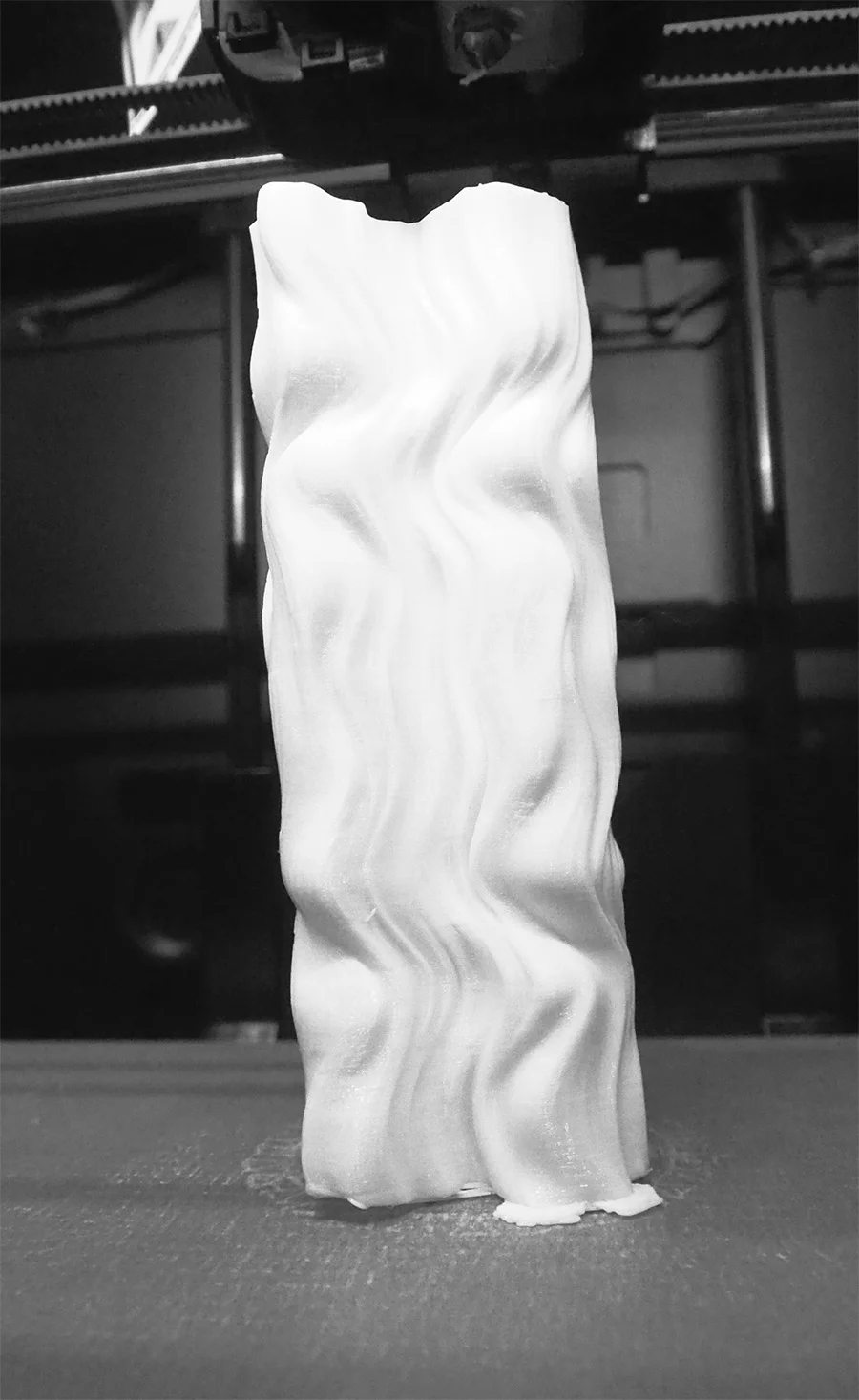
Digital fabrication and computational clay modeling have revived interest in growth-based and behavioral topologies, where form emerges from material properties and generative algorithms rather than purely from predetermined drawings. Working with clay as both a physical substance and a digital simulation allows designers to explore how surfaces buckle, slump, and self-organize under force and time. This dialogue between the tactile and the virtual yields complex geometries that feel simultaneously ancient and futuristic, grounded in earthen craft yet shaped by code.
Verticality and reparameterized form challenge the default assumptions of stacked floor plates and uniform grids. By recalibrating structural logic through algorithmic processes, architects can redistribute mass, light, and circulation in ways that feel more organic and less mechanical. Towers and pavilions alike can be reimagined as continuous landscapes rather than compartmentalized boxes. This reparameterization treats every design variable as open to negotiation, allowing gravity, view corridors, and thermal flows to become active co-authors of spatial organization.
Material ecologies invite a broader consideration of how building components are sourced, assembled, and eventually returned to natural cycles. Instead of specifying materials in isolation, designers working at this frontier examine entire lifecycles and the interdependencies between substances, energy inputs, and biological systems. The ambition is to close loops, reduce waste, and create assemblies that can be disassembled and repurposed. Such thinking aligns architectural production with ecological principles, treating the built environment as a temporary concentration of matter within larger flows.
Adaptive and responsive environments extend the conversation beyond static objects into realms of real-time interaction. Sensors, actuators, and embedded computation allow spaces to shift their acoustic, luminous, and thermal character in response to occupancy patterns and environmental cues. This behavioral approach to architecture treats buildings as ongoing performances rather than finished artifacts. The result is an architecture of subtle negotiation, where the boundary between user and space becomes porous and mutually influential, fostering a sense of co-presence between inhabitant and environment.
Memory and encoding in architecture refer to the ways buildings can store, express, and transmit information across time. Whether through materially embedded histories, digitally layered experiences, or parametrically varied surface patterns, structures become carriers of narrative and data. This encoded memory might manifest as a facade whose texture records environmental fluctuations or as an interior whose spatial sequence recalls cultural rhythms. Architecture thus operates as both a medium and a message, holding traces of past conditions while remaining open to future reinterpretation.
The vision behind a network dedicated to art, architecture, and technology rests on the belief that disciplinary boundaries limit what spaces can become. By fostering dialogue between practitioners who might otherwise remain siloed, such a platform encourages cross-pollination of methods, tools, and sensibilities. Workshops, publications, and collaborative events become catalysts for shared inquiry into complexity, formation, and adaptive design. The goal is not to dissolve distinctions but to build bridges across them, cultivating a community where experimentation and critical reflection continually inform one another.
Our Motto
Unity, Striving, Erudition, Dedication.
Established in 1998, these four words continue to guide the university's teaching, research and community life — anchoring AUST's identity as a public welfare institution committed to building a high-level teaching and research university with distinct characteristics.
Explore AUST
Find your way to governance, academic structure, leadership and campus resources.
Charter
The foundational charter outlining AUST's legal status, mission and governance principles.
Read Charter →University Profile
History, campus size, faculty strength and academic structure at a glance.
View Profile →Leadership
Meet Party Secretary Guo Yongcun and President Yuan Liang, plus the vice-presidents.
Meet Leadership →Faculties
20+ academic units spanning engineering, science, medicine and the humanities.
Browse Faculties →